

Voyaging up the Mississippi River from Louisiana in 1812, the Missouri Territory was everything to the left. Arbitrary lines of latitude and longitude were drawn to enclose that especially large, useful tributary of the Mississippi River, the Missouri River, at statehood in 1821.
The physiography of the resulting trapezoid turned out to be quite diverse. The bootheel section by the Mississippi River in the extreme southeast is a low, swampy alluvial plain. Most of the remainder of southern Missouri is the opposite - the deeply incised and sometimes-rugged Ozark Plateau. The northern and western quarters of the state are open grassland prairie, now heavily farmed, glaciated above the Missouri River and unglaciated below.
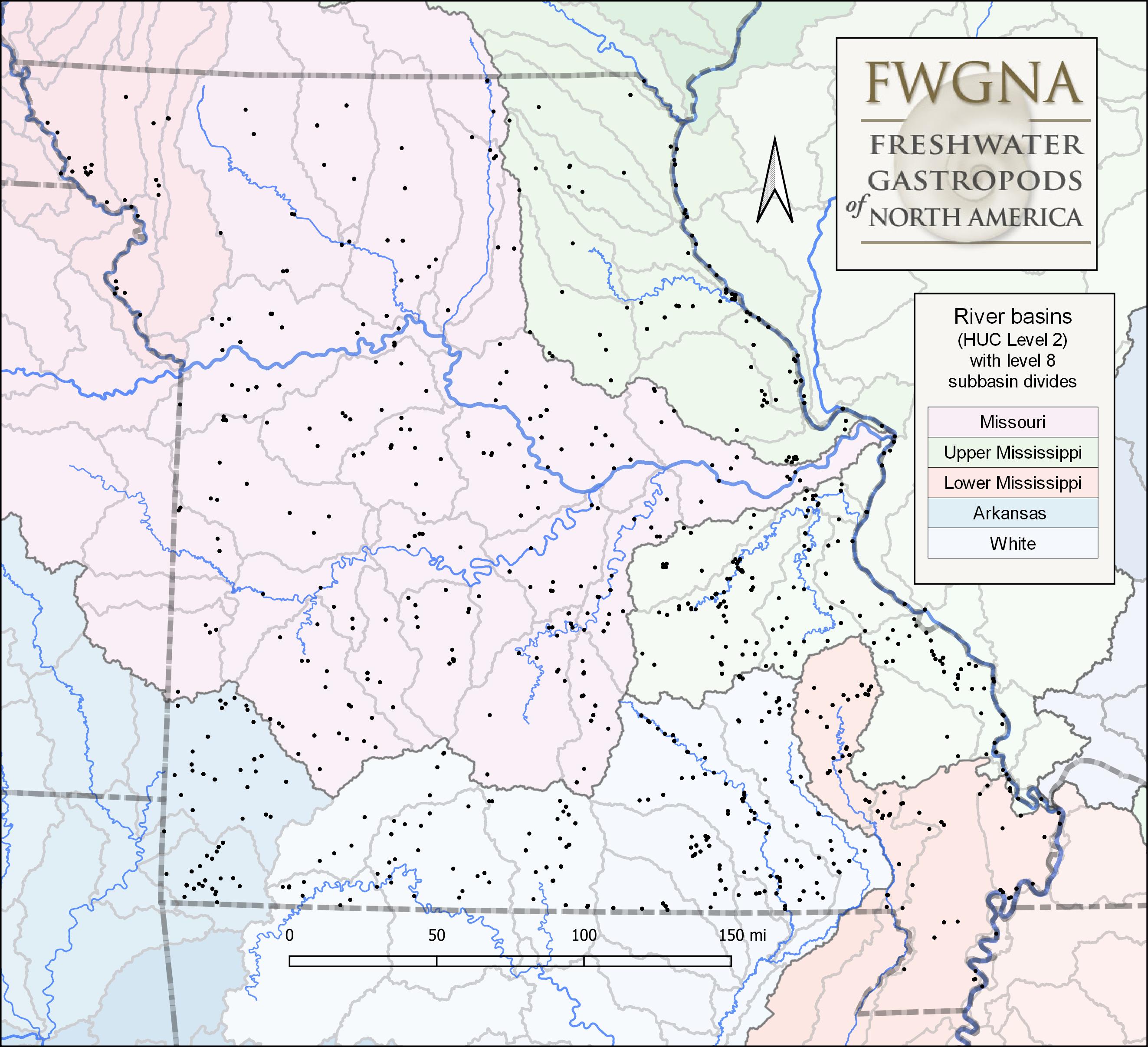
The Missouri River itself drains approximately half the state toward the east, shown in pink below, with prairie grasslands to the north and forested highlands to the south. The eastern quarter the state (green and orange) also drains eastward, but directly into the mighty Mississippi. And the southern quarter of Missouri drains south, toward Arkansas.
Figure 1. The major drainage basins of Missouri, showing sample sites.
Shocking though it most certainly is to our modern sensibilities, the malacological fauna of this diverse and far-flung trapezoid was entirely neglected by Meriwether Lewis, William Clark, and four generations of explorers, naturalists, and scientists who followed them. Systematic study of the Mollusca of Missouri was not conceived until 1883, when a lawyer named Francis Asbury Sampson published a sweet little note in an obscure, regional journal entitled, "The Shells of Sedalia." Thirty years later, when Sampson (1913) strode to the podium of The Academy of Science of St. Louis to deliver his " Preliminary List of the Mollusca of Missouri, Exclusive of the Unionidae," malacology was born in The Show-Me State.
Sampson documented county records (in many cases, more specific) for 4 viviparids, 5 hydrobioids, 10 pleurocerids, 9 lymnaeids, 10 physids, 6 planorbids and 2 ancylids, both living and subfossil, for a total state list of 46 nominal freshwater gastropod species and subspecies. Editing Sampson's list down by the combination of synonyms would yield a modest inventory of 25 biological species as we understand them today: 3 viviparids, 4 hydrobioids, 3 pleurocerids, 4 lymnaeids, 3 physids, 6 planorbids and 2 ancylids.
No history of American malacology can be written without a tip of the cap to Mr. Leslie R. Hubricht, who for over six decades travelled broadly across these United States surveying, cataloguing and describing our land and freshwater gastropod fauna from sea to shining sea. For most of his life, Hubricht was a resident of St. Louis. His painstaking research on the Ozark hydrobioids, focusing especially on the cave-dwelling species, was published in series 1940, 1941, 1942, and 1971, adding four species to the state list.
From his home base in Arkansas, Mark E. Gordon published several papers relevant to the Ozark sections of Missouri in 1982, 1986, and 1987. These studies presaged the 1997 publication of one of the best and most thorough surveys of a statewide freshwater gastropod fauna ever conducted, the splendid Missouri Aquatic Snails of Shi-Kuei Wu, Ronald D. Oesch, and Mark Gordon.
The details of the sampling program upon which that important Contribution #4 to the Missouri Natural History Series was based are not entirely clear. Wu and his colleagues stated that a statewide survey was initiated by R. D. Oesch in 1982, although the collections currently housed at the University of Colorado Museum in Boulder include Oesch samples dated as early as 1967, continuing onward into 1998, the year after the survey was published. The sampling effort seems to have been biased toward wadeable streams, and away from ponds, swamps, ditches, and lentic environments generally. The Mississippi and Missouri Rivers were also undersampled. No estimate of the total number of sample sites was offered by the authors.
The merits of the 97-page staple-bound booklet ultimately published in 1997, however, far outweigh any ambiguity in the collection methodology involved. Wu, Oesch and Gordon thoroughly documented 56 nominal species of gastropods inhabiting the waters of The Show-Me State, offering for each a set of diagnostic characters, an original drawing of the shell, remarks of both a taxonomic and an ecological nature, a list of records, and a detailed dot map of each species distribution.
Updating the taxonomy to modern standards, those 56 species would reduce to 39: 5 viviparids, 12 hydrobioids, 4 pleurocerids, 5 lymnaeids, 4 physids, 6 planorbids and 3 ancylids. The 1997 study did not confirm three species listed by Sampson in 1913: Pleurocera livescens, Lymnaea catascopium, and Promenetus exacuous. The 1997 inventory added, however, 17 species to Sampson's list: 8 hydrobioids (the 4 species subsequently described by Hubricht plus 4 apparently missed by earlier surveys) and 9 other species evenly scattered among the remaining families. See Table 1 [pdf], also downloadable as an [excel] spreadsheet.
In more recent years, research interest has focused primarily upon the cave-dwelling hydrobioid snails of conservation concern, especially Fontigens antroecetes (Taylor et al. 2013, Weck 2022) and Antrobia culveri (Ashley 2003, McKenzie 2003). Minton and colleagues (2011, 2017) have also contributed a pair of more recent evolutionary studies on Ozark/Ouachita populations of Pleurocera potosiensis and related species. See our upcoming essays on the FWGNA Blog for an elaboration.
> Methods
The majority of the records analyzed here were collected by Wu, Oesch and Gordan in connection with their 1997 monograph and deposited in the University of Colorado Museum. We visited the UCM in Boulder October 4-7, 2021, reviewing all Missouri freshwater gastropod collections. We were unable to find 170 Missouri lots as listed in the catalog, discovered 3 lots that were uncatalogued, and identified 34 mixed lots, which we split. We caught 7 pairs of duplicates - two different lots bearing the same catalog number. At the end of the process our spreadsheet of Missouri freshwater gastropods held by the University of Colorado Museum totaled 1,616 records.
We identified 36 species of freshwater gastropods in the Missouri collections at the UCM, significantly fewer than the 56 species listed by Wu and colleagues. The biggest revision was in the Physidae, which were reduced from 12 species to 4. The lymnaeids also shrank significantly, from 8 species to 4. On the plus side we identified one big-river lot of Pleurocera canaliculata canaliculata not previously documented from the state, plus one lot of Helisoma scalaris duryi, certainly an aquarium introduction.
The taxonomy employed by the FWGNA project is painstakingly researched, well-reasoned and insightful. Needless to say, it often differs strikingly from the gastropod taxonomy in common currency among casual users and most natural resource agencies. First-time visitors looking for information about particular species or genera might profitably begin their searches with a check for synonyms in our alphabetical index.
Our raw 1,616 record UCM database included many duplicates - often two or more lots collected from the same site, previously identified as different species of Physa, now synonymized. We also found a significant number of date duplicates - pairs of collections of the same species at the same place on different dates, and site duplicates - pairs of samples from the same body of water very closely neighboring. Culling and combining duplicates lowered our final database of freshwater gastropods held by the University of Colorado Museum to 1,261 records.
We also added 41 Missouri records held by the Illinois Natural History Survey, verified personally in June of 2017, and a single record from the Field Museum of Natural History Leslie Hubricht s type lot of Antrobia culveri (FMNH164171).
Our second important source of data on the freshwater gastropod fauna of The Show-Me State came from semi-quantitative macrobenthic samples collected from wadeable streams by the Missouri Department of Natural Resources Water Quality Monitoring Section 2015-2018. Methods of site selection and evaluation have been detailed by Sarver and colleagues (2002), and sampling procedures by Sarver & Michaelson (2024).
A multi-habitat sampling approach was used at each site, with four habitat types predominating: Riffle bottoms (coarse substrate CS), pool bottoms (non-flowing NF), marginal root-mats (RM), and large woody debris (snags SG). Kick nets were used for the first three of these habitats, the surface area sampled for each habitat type approximately 1 square meter. For SG samples, 12 pieces of woody debris were gently lifted from the bottom and adhering organisms from approximately 400-600 square centimeters of each scrubbed into a 44 x 50 cm "snag bag."
We visited the Jefferson City laboratory of the MoDNR-WQMS twice, first on 19Apr24 and again on 4Sept25, and were granted a total of 743 black-top 25 ml glass vials, each containing a sample from a single habitat type at a single site on a single date, fall 2015 through the fall 2018. Lumping habitat types and dates under their sites and combining sites that we judged too closely-neighboring, we were ultimately able to survey the freshwater gastropod fauna at 90 discretely different sites, yielding 322 records. We also identified three rare freshwater gastropod species sampled from single sites in previous years and held in the MoDNR reference collection, to yield a total of 325 records from the MoDNR-WQMS.
Our third source of data were from personal collections (132 records), specifically directed toward habitats undersampled by both Wu et al (1997) and by the MoDNR. These included isolated ponds and wetlands in the western prairie, ditches and wetlands in the SE boot heel, and the main Mississippi and Missouri Rivers, which we sampled at the historic low waters in September, 2023.
Our entire 1,760 record database is available (as an excel spreadsheet) from the senior author upon request. The approximately 788 unique sites sampled are mapped in Figure 1 above. No absence stations are shown. If freshwater gastropods were not collected at a site, then no record resulted.
> Results
The 44 species and subspecies of freshwater gastropods we were able to confirm from the state of Missouri, plus two species expected from previous surveys but not confirmed, are listed in Table 1, downloadable in [pdf] format and as a simple, sortable [excel] spreadsheet. All 44 are figured in the FWGMO Gallery and distinguished on the FWGMO Dichotomous Key Ecological and systematic notes for each species are provided on separate dedicated pages, together with state distribution maps. See the FWGMO Discussion page for a review of regional and continent-scale biogeography, and Synthesis v3.2 for an analysis of commonness and rarity.
> Discussion
> References
Ashley, D.C. (2003) A final report on the monitoring project to evaluate the population status of the Tumbling Creek cavesnail, Antrobia culveri (Gastropoda, Hydrobiidae). U.S. Fish & Wildlife Service, Columbia, MO. 93 pp.
Gordon, M.E. (1982) Mollusca of the White River, Arkansas and Missouri. Southwestern Naturalist 27: 347 352.
Gordon, M.E. (1986) A new Somatogyrus from the southwestern Ozarks with a brief review of the Hydrobiidae in the Interior Highlands. The Nautilus 100: 71 77.
Gordon, M. E. (1987) Habitat utilization, population dynamics, and production of three gastropods (Prosobranchia: Pleuroceridae) from the North Fork of the White River, Missouri, Ph.D. Dissertation, University of Arkansas, Fayetteville. 124 p.
Hubricht, L. (1940) The Ozark amnicolas. Nautilus, 53: 118-122.
Hubricht, L. (1941) The cave Mollusca of the Ozark region. Nautilus, 54: 111-112.
Hubricht, L. (1942) A new locality for Amnicola proserpina. Nautilus, 55: 105.
Hubricht, L. (1971) New Hydrobiidae from Ozark Caves. Nautilus, 84: 93-96.
Lewis, J.J., P. Moss, D. Tecic, and M.E. Nelson (2003) A conservation focused inventory of subterranean invertebrates of the southwestern Illinois karst. Journal of Cave and Karst Studies 65: 9 21.
McKenzie, P.M. (2003) Tumbling Creek cavesnail (Antrobia culveri) recovery plan. U.S. Fish & Wildlife Service, Ft. Snelling, MN. 97 pp.
Minton RL, Lewis EM, Netherland B, Hayes DM (2011) Large differences over small distances: plasticity in the shells of Elimia potosiensis (Gastropoda: Pleuroceridae). International Journal of Biology 3(1): 23-32.
Minton, R.L., B.L. McGregor, D.M. Hayes, C. Paight, and K. Inoue (2017) Genetic structuring in the pyramid Elimia, Elimia potosiensis (Gastropoda, Pleuroceridae), with implications for pleurocerid conservation. Zoosyst. Evol. 93(2) 437-449.
Sampson, F. A. (1883) Notes on the distribution of shells, III: The shells of Sedalia, Mo. Kansas City Review of Science and Industry 6: 551.
Sampson, F.A. (1913) A preliminary list of the Mollusca of Missouri (exclusive of the Unionidae). Transactions of the Academy of Sciences of St. Louis 22:67-108.
Sarver, R. and D. L. Michaelson (2024) Semi-quantitative macroinvertebrate stream bioassessent. Missouri Department of Natural Resources, Division of Environmental Quality Environmental Services Program. 28 pp.
Sarver, R., S. Harlan, C. Rabeni, and S.P. Sowa (2002) Biological criteria for wadeable/perennial streams of Missouri. Missouri Department of Natural Resources. 47 pp.
Taylor, S.J., R. Weck, M.R. Douglas, J. Tiemann, and C.A. Phillips (2013) Baseline monitoring and molecular characterization of the state endangered enigmatic cavesnail, Fontigens antroecetes (Hubricht 1940). Illinois Natural History Survey Technical Report 14: 1 24.
Weck, R.G. (2022) Life history observations of the Illinois state endangered Enigmatic Cavesnail, Fontigens antroecetes (Hubricht, 1940) made under simulated cave conditions. Subterranean Biology 43: 185 - 198.
Wu, S-K., Oesch, R. & Gordon, M. (1997) Missouri Aquatic Snails. Jefferson City: Missouri Department of Conservation. 97 pp.