
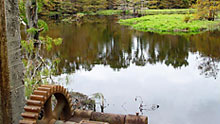
Both the Atlantic and the Gulf drainages of Georgia are covered, through the Florida panhandle... more
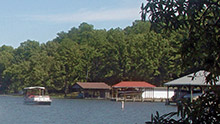
The four ecoregions of North Carolina drain toward the Atlantic through six major river systems... more
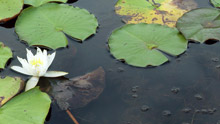
Although perhaps not as environmentally heterogeneous as neighboring states, South Carolina does include... more
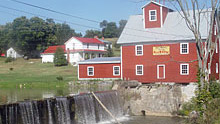
The survey reported here is focused on the eastern 75% of the state, draining from the Blue Ridge to the Atlantic... more
All waters draining into the Tennessee River above the Alabama line, including SW Virginia, W North Carolina, and N Georgia... more
A study area of approximately 150,000 km2, including Delaware, Maryland, New Jersey, eastern Pennsylvania and the West Virginia panhandle... more

A survey of all waters draining into the Ohio River upstream from the mouth of the Tennessee/Cumberland at River Mile 920... more
> Habitat & Distribution
Hubricht listed just two records for this obscure species in his original 1971 description, both in Perry County, Missouri. Wu and colleagues (1997) documented 8 additional populations, including two in Cape Girardeau County to the north. Wu s collection records at the University of Colorado Museum add two sites in Perry and one site in Iron County to the west. All records to date are from cave streams. FWGNA incidence unranked.
> Ecology & Life History
A broad-brush review of the zoogeography of North American cavesnails has been offered by Hershler & Holsinger (1990). Subterranean karst waters such as prevail in eastern Missouri are, of course, rich in calcium and many other minerals, as well as constant in their temperature. Such ecosystems are typically based on fine organic matter raining down from the lighted world above. Cavesnail populations typically demonstrate stable population densities year-round, as though reproduction might be continuous.
> Taxonomy & Systematics
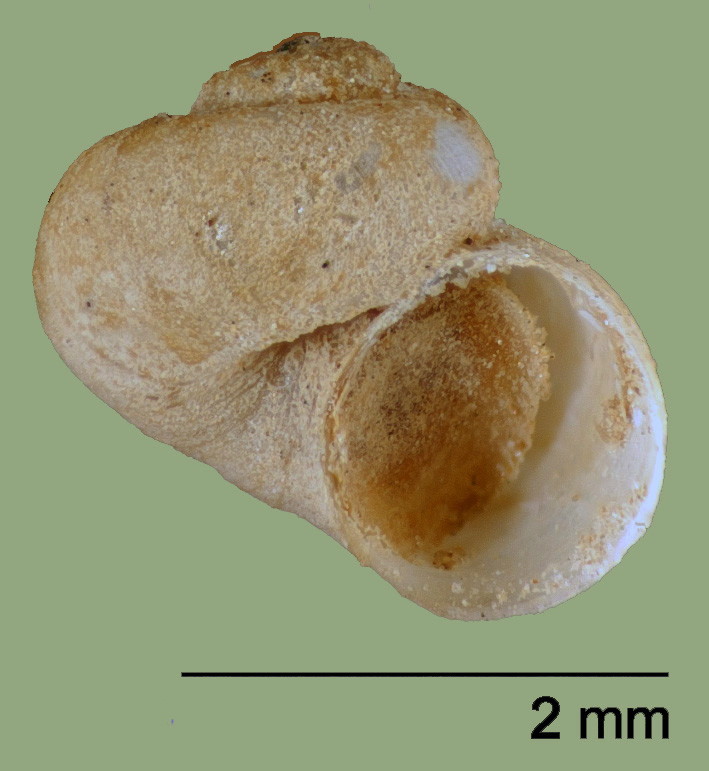
Hubricht (1971) described the animal as white and blind, without any trace of eyes. Otherwise, however, the anatomy of Amnicola stygia seems to match that of common and widespread A. limosa closely, their bifed penis morphology being identical. The 2.4 mm holotype shell (FMNH 164173) is figured above, courtesy of the Field Museum of Natural History.
Previous versions of this website follow ed Kabat & Hershler (1993) in recognizing the amnicolines as a subfamily in the diverse, equitable, and inclusive Hydrobiidae (sl). More recent molecular phylogenetic evidence has suggested raising this group to the full family level, Amnicolidae (Wilke et al., 2013). See my essay of 18Aug16 from the link below.
> Maps and Supplementary Resources
> Essays
- I wrote an essay on 22Aug07 about a hunt for the troglobitic hydrobiid Holsingeria unthanksensis in southwest Virginia, offering some observations likely relevant to the biology of Amnicola stygia as well. See Cave Snail Adventure.
- Earlier versions of this website, online until 18Aug16, adopted the large, broadly-inclusive concept of the Hydrobiidae (sl) following Kabat & Hershler (1993). More recently the FWGNA project has shifted to the Wilke et al. (2013) classification system, distinguishing a much smaller Hydrobiidae (ss) and elevating many hydrobioid taxa previously ranked as subfamilies to the full family level. For more details, see The Classification of the Hydrobioids.
> References
Hershler, R. H. & J. R. Holsinger (1990) Zoogeography of North American hydrobiid cavesnails. Stygologia 5: 5-16.
Hubricht, Leslie (1940) The Ozark Amnicolas. Nautilus 53: 118 122.
Hubricht, Leslie (1971) New Hydrobiidae from Ozark Caves. Nautilus 84: 93 96.
Kabat, A.R., and R. Hershler (1993) The prosobranch snail family Hydrobiidae (Gastropoda: Rissooidea): review of classification and supraspecific taxa. Smithsonian Contributions to Zoology 547:1-94.
Wilke T., Haase M., Hershler R., Liu H-P., Misof B., Ponder W. (2013) Pushing short DNA fragments to the limit: Phylogenetic relationships of hydrobioid gastropods (Caenogastropoda: Rissooidea). Molecular Phylogenetics and Evolution 66: 715-736.
Wu, S-K., R.D. Oesch, and M.E. Gordon (1997) Missouri Aquatic Snails. Missouri Department of Conservation Natural History Series No. 5. 97 pp.