
Both the Atlantic and the Gulf drainages of Georgia are covered, through the Florida panhandle... more
The four ecoregions of North Carolina drain toward the Atlantic through six major river systems... more
Although perhaps not as environmentally heterogeneous as neighboring states, South Carolina does include... more
The survey reported here is focused on the eastern 75% of the state, draining from the Blue Ridge to the Atlantic... more
All waters draining into the Tennessee River above the Alabama line, including SW Virginia, W North Carolina, and N Georgia... more
A study area of approximately 150,000 km2, including Delaware, Maryland, New Jersey, eastern Pennsylvania and the West Virginia panhandle... more

A survey of all waters draining into the Ohio River upstream from the mouth of the Tennessee/Cumberland at River Mile 920... more
> Habitat & Distribution
Populations of Fontigens antroecetes are restricted to cave streams in eastern Missouri and western Illinois. In his original description, Hubricht (1940) listed cave populations in St Louis, Crawford, Phelps, and Shannon Counties, Missouri, as well as the type locality in Stemler Cave, St. Clair County, Illinois. Hershler et al. (1990) documented populations in seven caves in Perry County, MO, to which Wu et al. (1997) added six more.
Taylor et al (2013) reported that 75% of the individual F. antroecetes recovered from their quadrat study of the type population were crawling on the bottoms of rocks, cobbles, and gravels, with another 22% on the sides. Snail density was negatively correlated with the rate of water flow.
A broad-brush review of the zoogeography of North American cavesnails has been offered by Hershler & Holsinger (1990), and a more detailed review for the genus Fontigens by Gladstone and colleagues (2021). FWGNA incidence unranked.
> Ecology & Life History
Fontigens antroecetes is apparently an obligate stygobiont (or troglobiont), known only from caves, blind and entirely unpigmented.
Taylor et al. (2013) speculated that the type population in Stemler Cave might demonstrate an annual life cycle driven by a spring pulse of nutrients, eggs primarily laid in the summer. In the laboratory under constant cave conditions, Weck (2022) reported approximately one year to maturity (3 mm), constant low levels of reproduction (25 - 80 eggs/pair/yr), and a lengthy hatch time of 70 - 80 days.
> Taxonomy & Systematics
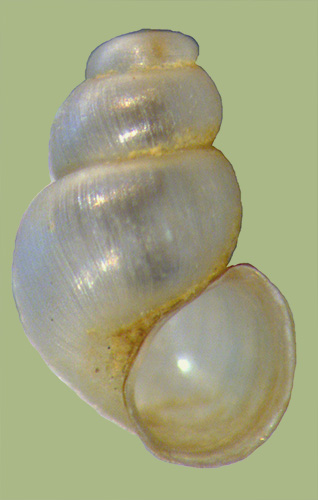
Hubricht (1940) originally described antroecetes as a subspecies of Amnicola aldrichi. The taxon was shifted to Fontigens (Pilsbry 1933) and raised to the species level by Peck and Lewis (1978). Fontigens antroecetes was one of the nine species reviewed by Hershler, Holsinger, and Hubricht in their splendid monograph of 1990. The image of the 2.8 mm paratype shell above (USNM 535852) is reproduced courtesy of the National Museum of Natural History.
A detailed shell-morphological analysis of all nine Hershler species has been contributed by Gladstone et al (2021). The elaborate penis bears three accessory lobes, which prompted Hershler and colleagues to join it with F. proserpina and F. bottimeri into a bottimeri group.
Taylor and colleagues (2013) sequenced mitochondrial 16s genes for N = 36 F. antroecetes sampled from five caves: three in Perry County, one in St. Louis County, and the type locality in Stemler Cave, St. Clair County, Illinois. The sequences were remarkably homogeneous, a maximum divergence of 1.06% recorded across the entire set of 36. Each population was distinguished by a unique haplotype, differing by a few nucleotides at most.
A sample of 6 F. antroecetes from the type locality was included in the survey of CO1 sequence diversity across 13 populations of 9 Fontigens species published by Liu and colleagues (2021). As might have been predicted from penial morphology, the species most genetically similar to F. antroecetes was the eastern F. bottimeri. See my essay of 9Aug22 from the link below for a review.
Dwight Taylor (1966) suggested that Fontigens comprises a distinct hydrobiid subfamily, the Fontigentinae, which Hershler et al. (1990) synonymized under the Emmericiinae of Brusina (1870). Wilke et al. (2013) did not confirm a close association between Fontigens (represented by but a single sample) and the European genus Emmericia, however, tentatively returning the Fontigentinae to subfamilial status. Despite this evidence, self-appointed experts insisted on placing Fontigens in the Emmericiidae for several years (Bouchet et al. 2017), until Gladstone & Whelan (2022) split the genus to its own separate family, the Fontigentidae.
> Maps and Supplementary Resources
> Essays
- I wrote an essay on 22Aug07 about a hunt for the troglobitic hydrobiid Holsingeria unthanksensis in southwest Virginia, offering some observations likely relevant to the biology of Fontigens antroecetes as well. See Cave Snail Adventure.
- Earlier versions of this website, online until August of 2016, adopted the large, broadly-inclusive concept of the Hydrobiidae (sl) following Kabat & Hershler (1993). More recently the FWGNA project has shifted to the Wilke et al. (2013) classification system, distinguishing a much smaller Hydrobiidae (ss) and elevating many hydrobioid taxa previously ranked as subfamilies to the full family level. For more details, see The Classification of the Hydrobioids.
- See my essay of 9Aug22, Startled by Fontigens, sort-of, I suppose for a review of the paper by Liu et al. (2021) documenting unusually high levels of intraspecific mtDNA sequence divergence among populations of Fontigens throughout eastern North America.
> References
Bouchet, P., J. Rocroi, B. Hausdorf, A. Kaim, Y. Kano, A. Nutzel, P. Parkhaev, M. Schrodl, and E. Strong (2017) Revised classification, nomenclator and typification of gastropod and monoplacophoran families. Malacologia, 61: 1 526.
Craig, J.L. (1975) A checklist of the invertebrate species recorded from Missouri subterranean habitats. Missouri Speleology 15: 1 10.
Gladstone, N.S., E. Pieper, S. Keenan, A. Paterson, M. Slay, K. Dooley, A. Engel, and M. Niemiller (2021) Discovery of the Blue Ridge springsnail, Fontigens orolibas Hubricht 1957 (Gastropoda: Emmericiidae) in East Tennessee and its conservation implications. Freshwater Mollusk Biology and Conservation 24: 34 - 42.
Gladstone, N. S. and N. Whelan (2022) Pushing barcodes to their limits: phylogenetic placeament of Fontigens Pilsbry, 1933 (Caenogasatropoda: Littorinimorpha: Truncatelloidea) and elevation of Fontigentidae Taylor, 1966. Journal of Molluscan Studies 88: eyab038.
Hershler, R. H. & J. R. Holsinger (1990) Zoogeography of North American hydrobiid cavesnails. Stygologia 5: 5-16.
Hershler, R., J.R. Holsinger & L. Hubricht (1990) A revision of the North American freshwater snail genus Fontigens (Prosobranchia: Hydrobiidae). Smithsonian Contributions to Zoology 509:1-49.
Hubricht, Leslie (1940) The Ozark Amnicolas. Nautilus 53: 118 122.
Kabat, A.R., and R. Hershler (1993) The prosobranch snail family Hydrobiidae (Gastropoda: Rissooidea): review of classification and supraspecific taxa. Smithsonian Contributions to Zoology 547:1-94.
Liu, H-P., L. Schroeder, A. Berry, and R. T. Dillon, Jr. (2021) High levels of mitochondrial DNA sequence divergence among isolated populations of Fontigens (Truncatelloidea: Emmericiidae) in eastern USA. Journal of Molluscan Studies 87: eyab026. [pdf]
Peck, S.B., and J.J. Lewis (1978) Zoogeography and Evolution of the Subterranean Invertebrate
Faunas of Illinois and Southeastern Missouri. National Speleological Society Bulletin, 40:39-63.
Pilsbry, H.A. (1933) Amnicolidae from Wyoming and Oregon. Nautilus 64: 37 39.
Taylor, D.W. (1966) Summary of North American Blancan nonmarine molluscs. Malacologia 4: 1 - 172.
Taylor, S.J., R. Weck, M.R. Douglas, J. Tiemann, and C.A. Phillips (2013) Baseline monitoring and molecular characterization of the state endangered Enigmatic Cavesnail, Fontigens antroecetes (Hubrich 1940). Final Report to the Illinois Endangered Species Protection Board. 24 pp.
Weck, R.G. (2022) Life history observations of the Illinois state endangered Enigmatic Cavesnail, Fontigens antroecetes (Hubricht, 1940) made under simulated cave conditions. Subterranean Biology 43: 185 - 198.
Wilke T., Haase M., Hershler R., Liu H-P., Misof B., Ponder W. (2013) Pushing short DNA fragments to the limit: Phylogenetic relationships of hydrobioid gastropods (Caenogastropoda: Rissooidea). Molecular Phylogenetics and Evolution 66: 715-736.
Wu, S-K., R.D. Oesch, and M.E. Gordon (1997) Missouri Aquatic Snails. Missouri Department of Conservation Natural History Series No. 5. 97 pp.