
Both the Atlantic and the Gulf drainages of Georgia are covered, through the Florida panhandle... more
The four ecoregions of North Carolina drain toward the Atlantic through six major river systems... more

Although perhaps not as environmentally heterogeneous as neighboring states, South Carolina does include... more

The survey reported here is focused on the eastern 75% of the state, draining from the Blue Ridge to the Atlantic... more
All waters draining into the Tennessee River above the Alabama line, including SW Virginia, W North Carolina, and N Georgia... more
A study area of approximately 150,000 km2, including Delaware, Maryland, New Jersey, eastern Pennsylvania and the West Virginia panhandle... more

A survey of all waters draining into the Ohio River upstream from the mouth of the Tennessee/Cumberland at River Mile 920... more
Goniobasis lawrencii
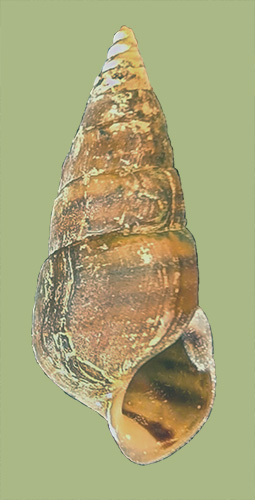
> Habitat & Distribution
Populations of P. canaliculata lawrencii are widespread in rivers and streams of the Ozark Highlands, from the Gasconade and Meramec drainages of Missouri south through the White River drainages of Arkansas, ranging as far west as Kansas. We are aware of spotty populations in the Saline and Arkansas River systems, but the species seems to have been extirpated from its type locality in the Ouachita River, at the southern edge of its range.
Combined with the other three subspecies of Pleurocera canaliculata (typical, acuta, pyrenellum) however, the species range is vast - extending throughout the interior drainages of North America, from Vermont through the Midwest to Minnesota, south to Tennessee and Louisiana. FWGNA incidence rank I-5, very common.
Populations of P. canaliculata lawrencii seem to reach maximum densities in small rivers of the third or fourth order, especially in calmer waters at stream edge, grazing through silt and thick layers of periphyton.
> Ecology & Life History
We are not aware of any ecological study directed toward populations of Pleurocera canaliculata lawrencii. But by virtue of the excellent monograph of Dazo (1965), the acuta subspecies of P. canaliculata is one of the best-known prosobranchs inhabiting North American freshwaters. Dazo's laboratory populations plowed "somewhat sluggishly" through the sandy bottoms of their aquaria, rostrums extended, sweeping from side to side. Gut content analysis from the field suggested a generalized grazing habit, composed of "red and green algae, desmids, and diatoms."
Both Dazo's laboratory and field observations agreed that mating takes place during the fall. The animals hibernated when water temperatures fell below 5 degrees C, emerging in the spring to lay eggs. Dazo reported that sand-covered eggs were laid on hard surfaces in batches of varying sizes and shapes, the number of eggs per mass varying from 1 - 19. He observed a fecundity of approximately 15 eggs/snail/day in his field population of P. canaliculata acuta, April to June. Hatch time was approximately 2 weeks.
Two years were required to reach maturity in Dazo's lab populations, at approximately 16 mm standard shell length, "after which no appreciable growth occurred." Both his field and his laboratory observations returned a 2:1 female bias in mature sex ratio. Dazo suggested that adults in his Michigan populations of P. canaliculata acuta "attain an age of about three years" and "may extend to 4 years perhaps," reproducing annually. This is life cycle Hi of Dillon (2000: 156 - 162).
The observations of Houp (1970) on a Kentucky population of P. canaliculata acuta agreed in most respects with those of Dazo in Michigan, although she recorded a field sex ratio of 1:1. Egglaying took place in July and August in Houp's study population, and her results "did not give a clear-cut indication of survivial beyond the second year."
> Taxonomy & Systematics
See Dazo's (1965) paper for marvelously detailed anatomical drawings, notes, and observations on the muscular, digestive, reproductive, circulatory, and nervous systems of Pleurocera canaliculata acuta. His inability to document any significant anatomical difference between Pleurocera and what was at that time called Goniobasis (or "Elimia") livescens in any respect was crucial in the subsequent unification of the two genera by Dillon (2011). See my essay of 23March11 from the link below for more.
Isaac Lea described Goniobasis lawrencii from the Ouachita River in the vicinity of Hot Springs, Arkansas, in 1869. The species was synonymized under Pleurocera acuta (Raf. 1831) by Goodrich (1927, 1939).
Rafinesque's nomen acuta was lowered to the subspecific level under P. canaliculata by Dillon and colleagues (2013). See the pair of related essays I posted on the FWGNA blog in June of that year (links below) for a complete review. And in 2026 Isaac Lea's nomen lawrencii was itself resurrected at the subspecific level to describe the distinctive populations of P. canaliculata inhabiting rivers of the Ozark HIghlands. For more about that act see my essay of 15Sept26.
Dillon (1991) reported that the karyotype of P. canaliculata acuta sampled from Dazo's (1965) Toma Road Bridge site is 2N = 36, as was the the karyotype of a typical P. canaliculata population sampled from the Elk River near Fayetteville, TN).
> Maps and Supplementary Resources
- Pleurocerid distribution in The Great Plains (2024)
- Pleurocera canaliculata distribution in Missouri (2026)
> Essays
- Pleurocera canaliculata made a small (but important) guest appearance in my blog post of 10Nov10, Joe Morrison and the great Pleurocera controversy.
- Taxonomic controversy has surrounded the generic nomina Pleurocera, Goniobasis, and Elimia for many years. The best entry into the subject would be my essay of 23Mar11, entitled Goodbye Goniobasis, Farewell Elimia. Links are available from that essay to older resources.
- I offered a (rather formal) review of the paper by Dillon, Jacquemin & Pyron in my essay of 3June13, Pleurocera acuta is Pleurocera canaliculata.
- On 18June13 I posted a much more personal account of the observations (and wanderings, and blunderings) that ultimately culminated in the research of Dillon, Jacquemin & Pyron, Pleurocera canaliculata and the process of scientific discovery.
- The biological and taxonomic relationships between P. canaliculata canaliculata and P. canaliculata pyrenellum were touched upon briefly in a pair of related essays, What Is A Subspecies? (4Feb14) and What Subspecies Are Not (5Mar14).
- I reviewed the entire phenomenon of cryptic phenotypic plasticity in P. canaliculata in my blog post of 2June16, The Shape-shifting Pleurocera of North Alabama. That essay featured several good figures illustrating the range of shell morphology that can be displayed by populations of this species.
- On 15Sept26 I resurrected Isaac Lea's (1869) nomen Goniobasis lawrencii at the subspecific level and applied it to populations previously identified as Pleurocera acuta throughout Ozark rivers of Missouri, Arkansas, and Kansas. See The Peculiar Pleurocerids of The Interior Highlands III: Pleurocera canaliculata lawrencii.
> References
Dazo, B. C. (1965) The morphology and natural history of Pleurocera acuta and Goniobasis livescens (Gastropoda: Cerithiacea: Pleuroceridae). Malacologia 3: 1 - 80.
Dillon, R. T., Jr. (1989) Karyotypic evolution in pleurocerid snails: I. Genomic DNA estimated by flow cytometry. Malacologia, 31: 197-203.
Dillon, R.T. (1991) Karyotypic evolution in pleurocerid snails. II. Pleurocera, Goniobasis, and Juga. Malacologia 33: 339-344.
Dillon, R. T., Jr. (2000) The Ecology of Freshwater Molluscs. Cambridge, Cambridge University Press. 509 pp.
Dillon, R. T., Jr. (2011) Robust shell phenotype is a local response to stream size in the genus Pleurocera (Rafinesque, 1818). Malacologia 53: 265-277.
Dillon, R. T. Jr., & K. B. Davis (1991) The diatoms ingested by freshwater snails: temporal, spatial, and interspecific variation. Hydrobiologia 210: 233-242.
Dillon, R. T., Jr., S. J. Jacquemin & M. Pyron (2013) Cryptic phenotypic plasticity in populations of the freshwater prosobranch snail, Pleurocera canaliculata. Hydrobiologia 709: 117 127. [html] [pdf]
Goodrich, C. (1927) Some misplaced pleurocerids. Nautilus 41: 57 62.
Goodrich, C. (1939) Pleuroceridae of the Mississippi River basin exclusive of the Ohio River system. Occasional Papers of the Museum of Zoology, University of Michigan 406: 1 4.
Goodrich, C. (1940) The Pleuroceridae of the Ohio River drainage system. Occas. Pprs. Mus. Zool. Univ. Mich., 417: 1-21.
Lea, I. (1869) Descriptions of six new species of fresh water shells. Proceedings of the Academy of Natural Sciences of Philadelphia 21: 124 125.
Lea, I. (1874) Supplement to Isaac Lea s paper on Unionidae. Journal of the Academy of Natural Sciences of Philadelphia (Second Series) 8: 55 69.
Houp, K. (1970) Population dynamics of Pleurocera acuta in a central Kentucky limestone stream. Amer. Midl. Natur. 83: 81-88.
Magruder, S. R. (1934) Notes on the life history of Pleurocera canaliculata undulatum Say. The Nautilus 48: 26-28.
Strong, E. E. (2005) A morphological reanalysis of Pleurocera acuta Rafinesque 1831 and Elimia livescens (Menke 1830). The Nautilus 119: 119-132.
Whelan, N.V. & E. E. Strong (2014) Seasonal reproductive anatomy and sperm storage in pleurocerid gastropods (Cerithioidea: Pleuroceridae) Can. J. Zool. 92:989-995.